Notting Hill murderer
The Hound of the BaskervillesThe Notting Hill murderer is an escaped convict hiding on the moor, whose presence makes the surrounding countryside feel more dangerous and whose concealed connection to the household at Baskerville Hall explains its unexplained night signals. He is identified as Eliza Barrymore’s younger brother: a man feared for his criminal past, yet still regarded by his sister as the boy she once cared for. That tension between public menace and private loyalty drives the account of his concealment.
Identity and Background
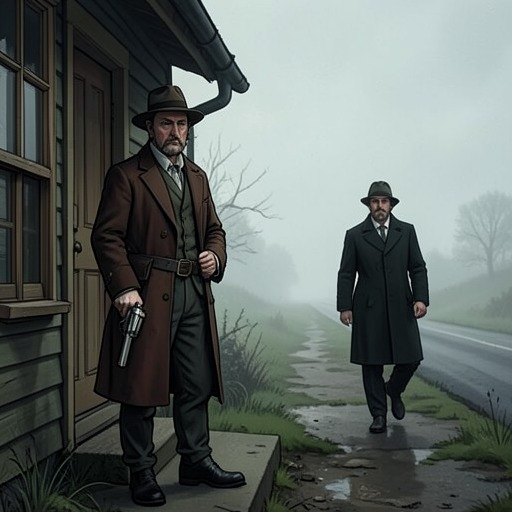
The Notting Hill murderer is identified by the driver Perkins as the convict who escaped from Princetown. At the time the travelers hear of him, he has been at large for three days. Warders are watching roads and stations, but have not seen him; local farmers fear the danger of encountering him more than they value the offered reward for information. The report presents his escape not as an ordinary case of a fugitive evading custody, but as a threat that has unsettled the district.
Dr. Watson recognizes the name from a case in which Sherlock Holmes had taken an interest. The crime was notorious for its extreme ferocity, and doubts about the prisoner’s sanity had led to the commutation of his death sentence. These details explain both the community’s alarm and the weight attached to his being loose. The account gives no new description of his crimes; it establishes their reputation as the reason the news changes the travelers’ perception of the landscape ahead.
Escape and Concealment on the Moor
The Notting Hill murderer is hiding somewhere on the moor as the travelers approach Baskerville Hall. The bleak setting and the report of a fugitive arrive together: what had been a journey through an unfamiliar region becomes a journey through territory where an unseen person is believed to be at large. Sir Henry Baskerville grows silent at the news. The fugitive’s location is not initially known to the household, and his concealment depends on staying away from roads and stations watched by the authorities.
His escape brings him to the home of his sister and her husband. Eliza Barrymore explains that he came there exhausted and hungry, with the warders close behind him. They took him in, fed him, and cared for him; later, when he decided that the moor was safer than remaining near the house, they continued to help him while he hid there. His presence is therefore concealed both by distance from ordinary routes and by the deliberate assistance of people inside Baskerville Hall.
Family History and Eliza Barrymore’s Loyalty
Eliza Barrymore says that the Notting Hill murderer is her younger brother and that she was born with the family name Selden. She recalls that he was indulged as a boy and allowed to have his own way, then fell in with bad companions as he grew older. In her account, his crimes accumulated over time, bringing distress to their mother and disgrace to the family. She sees his survival of the death sentence as a reprieve, but does not mistake it for innocence or deny the damage he caused.
Her account also explains why she continues to help him. She remembers him not only as the notorious criminal he became but as the little boy she had nursed and played with. That childhood memory does not erase his later actions; it shows the personal bond through which she interprets them. She says he broke prison knowing that she was at Baskerville Hall and expecting that she would not refuse him help. The choice to shelter him is presented as an act of family loyalty, made despite the risks his escape creates.
Signals, Assistance, and the Household Secret
The household’s nighttime lights form a practical communication system. Every second night, a light in a window tells the Notting Hill murderer that food is ready; a answering light from the moor indicates where it should be brought. Barrymore carries bread and meat to him. The repeated exchange lets the couple check that he remains nearby and supply him without bringing him back into the house. It also accounts for the stealthy nighttime journeys and the light that had aroused suspicion.
When confronted, Eliza Barrymore accepts responsibility for the arrangement and insists that her husband acted for her sake. Barrymore confirms that the secret was not a scheme against Sir Henry Baskerville. The revelation changes the meaning of the lights and the couple’s secrecy: they have been protecting a fugitive relative, not participating in a plot against their guest. Their assistance nevertheless prolongs his concealment and places the household inside the consequences of his escape.
Narrative Role
The Notting Hill murderer remains largely outside the household’s view, but the threat associated with his name first makes the moor seem perilous and then supplies a concrete explanation for the hidden signals. His identity is disclosed through the testimony of his sister, so the reader learns not only where the nightly food goes but why the couple have risked helping him. The contrast between the public account of a dangerous escaped convict and Eliza Barrymore’s enduring memory of her brother gives the secret a family history without undoing the fear surrounding his crimes.